
Coral has begun to colonize a replica moai statue in waters near Easter Island's Honga Roa dock.
Photos by Enric Sala
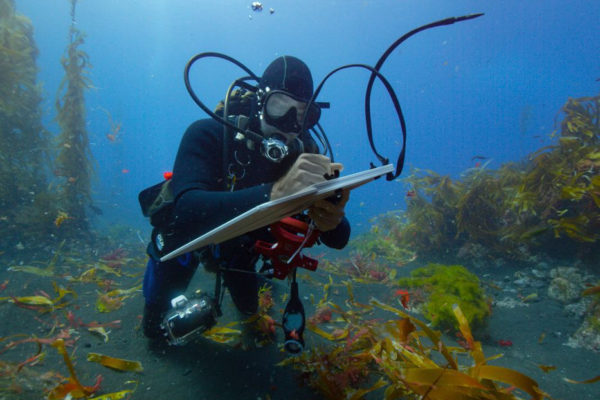
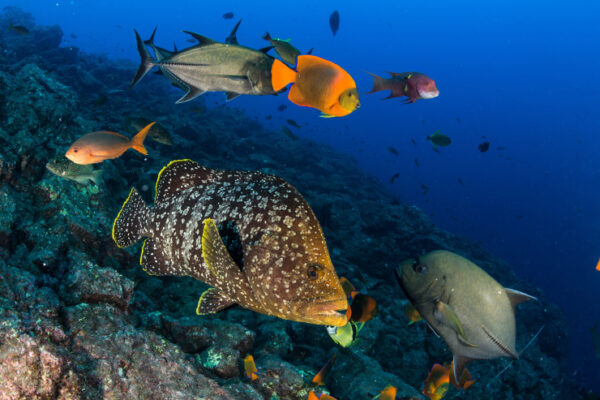
SANTIAGO, Chile, May 26, 2011—Oceana and National Geographic are reporting the findings of their unprecedented expedition to the island of Salas y Gómez and to Easter Island (Motu Motiro Hiva and Rapa Nui), conducted in February with the collaboration of the Chilean Navy. Their report highlights that both Salas y Gómez and Easter Island have one of the highest endemic fish populations for oceanic islands in the world.
"Our work in Chile provides us with considerable information in terms of understanding ocean life in the Motu Motiro Hiva Marine Park and its surroundings. It is the first quantitative study conducted in Motu Motiro Hiva and Rapa Nui, and data collected here reveal that both islands are a biodiversity hotspot for reef fish," said Dr. Enric Sala, marine ecologist and National Geographic Ocean Fellow.
The report reveals that 77 percent of individual fish species in Easter Island and 73 percent in Salas y Gómez are endemic. The expedition also confirmed that 53 percent of the seabed in Easter Island and 44 percent in Salas y Gómez contains live corals, with an excellent conservation status, that serve as habitat for several species of fish and invertebrates.
"The scientific report points to the relevance of the marine ecosystems located within and outside the Motu Motiro Hiva Marine Park. At the same time, it reveals the overfishing of marine resources in Easter Island and evidence of illegal fishing in Motu Motiro Hiva. We are working with the Rapa Nui people, the Chilean government and the Chilean Congress to take measures to help protect this unique ecosystem, not only for conservation purposes but also to increase the fishing resources for the Rapa Nui people,” said Oceana’s Vice President for South America, Alex Muñoz.
The expedition revealed the negative impacts of overfishing in Easter Island, showing, for instance, that fish numbers are three times lower there compared to Salas y Gomez, although both islands share the same environmental conditions. While large predators like sharks, horse mackerel and yellowtail amberjacks account for 43 percent of reef fish in Salas y Gómez, sharks were not found around Easter Island, and the other large species were found in low abundance there.
"Motu Motiro Hiva Marine Park is a considerable step forward for marine conservation, but it does not cover all the seamounts surrounding the island. In the future, Chile should extend the conservation measures to cover relevant areas that were not considered. These seamounts constitute stations that allow for connectivity between the ecosystems of Easter Island and Salas y Gómez, and therefore they could be very important for the recovery of some of Easter Island’s fisheries,” said expedition member Dr. Carlos Gaymer of Universidad Católica del Norte.
Oceana staff recently met with local decision-makers and stakeholders in Easter Island to share the report and discuss the next steps required for the protection of the marine resources of the Rapa Nui community. At the end of April, representatives from Oceana and National Geographic met with Chilean President Sebastián Piñera and shared the most relevant findings of the scientific study, expressing the need to extend the area of the Motu Motiro Hiva Marine Park.
For Further Information:
Annelore Hoffens, Oceana, 56 2 925-5603, ahoffens@oceans.org
Glynnis Breen, National Geographic, 1 (202) 857-7481, gbreen@ngs.org
Expedition Coverage
-
Pitcairn Expedition
Nat Geo Explorer-in-Residence Enric Sala leads an expedition to document one of the most untouched undersea environments left on Earth.
-
When the Ship Hits the Reef
NG Explorer-in-Residence Enric Sala reveals the impact a shipwreck can have, turning healthy seas into a "black reef."
-
Pristine Seas Expeditions
Pristine Seas is an exploration, research, and conservation project that aims to find, survey, and help protect the last healthy, undisturbed places in the ocean.
Video: NG Live! Pitcairn Islands
National Geographic Explorer-in-Residence Enric Sala dives deep into the waters of one of the most pristine places on Earth—the Pitcairn Islands—only to discover its delicate ecosystem is not as unspoiled as it may seem.
Advertisement
Support the Ocean
Help protect the last healthy, undisturbed places in the ocean so we can learn how to help healthy reefs thrive, help unhealthy reefs recover, and better preserve the ocean.
Ocean Topics
-
Acidification
-
Ballard, Robert
-
Bowermaster, Jon
-
Cook-Wise
-
De Rothschild, David
-
Doubilet, David
-
Earle, Sylvia
-
Frozen Seafood Benefits
-
Goodman, Beverly
-
Habitat Destruction
-
Invasive Species
-
Kristof, Emory
-
Marine Food Chain
-
Marine Pollution
-
Nicklen, Paul
-
Norman, Brad
-
Ocean Overview
-
Overfishing
-
Plastiki
-
Pristine Seas Expeditions
-
Sala, Enric
-
Seafood Decision Guide
-
Seafood Substitutions
-
Sea Level Rise
-
Sea Temperature Rise
-
Seaver, Barton
-
Sustainable Seafood
-
Thys, Tierney
-
Tips to Save the Ocean
Your Ocean
-
For Kids
Learn about the ocean with activities, photos, and games.
-
Ocean Education
Bring engaging and important ocean learning to your classroom.
Explore the Ocean
-
Ocean Life
Order ocean books, DVDs, maps, and more from the National Geographic online store.
-
Ocean Special Issue
Explore the world's oceans, from their prehistoric beginnings to modern-day efforts to preserve their natural wonder.
-
Ocean: An Illustrated Atlas
Immerse yourself in the wonders of the deep through colorful maps, photos, and satellite images.
Engage, Conserve, Restore
-
Freshwater Initiative
The National Geographic Society’s freshwater initiative is a multi-year global effort to inspire and empower individuals and communities to conserve freshwater and preserve the extraordinary diversity of life that rivers, lakes, and wetlands sustain.